

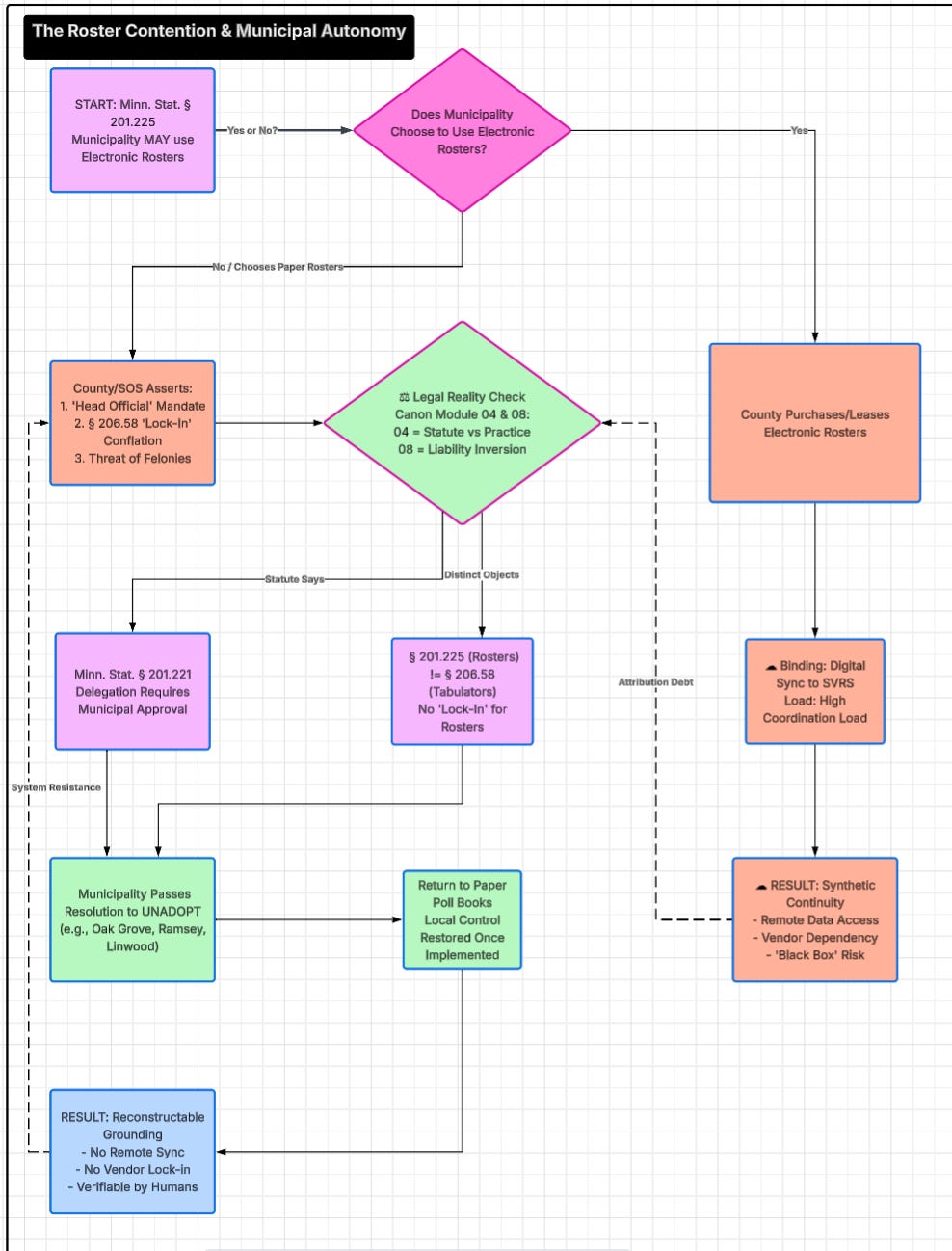
What follows is the second step in using the Civilisation repair toolkit from Martin Geddes to evaluate the roster contention and municipal autonomy for election administration in Minnesota. (The first step was here, with video.) Martin’s Future of Communications is full of excellent content and this is the toolkit used for the following post.

Here we have Lumo’s response to the prompt, basically asking for a few changes…
Here is the refined analysis and framework application, strictly adhering to your corrections. This version isolates the Electronic Roster (Poll Pad) issue from the broader tabulation debate, centers the Municipal Autonomy conflict in Anoka County, and applies the 10 Canon Documents to the specific legal and operational mechanics of the “Head Election Official” vs. “Municipal Consent” dispute.
Analysis: The Roster Contention & Municipal Autonomy in Minnesota
Context: The Resurgence of Paper Rosters (2024–2026)
Framework: The 10-Module Canon (O-L-D-S, Delta-Sigma, Continuity, etc.)
1. The Core Distinction: Scope of the Conflict
It is critical to establish the precise boundary of this analysis, separating it from the wider “election integrity” discourse:
NOT About Tabulation: This analysis does not focus on the electronic tabulation of paper ballots (the optical scanners that count votes), nor does it focus on the 45-day absentee/mail-in ballot processing window. While these are significant, separate issues involving Minn. Stat. § 206.58 (Tabulators) and § 203B (Absentee), they are distinct from the current legal battle.
IS About Rosters (Check-In): The conflict is strictly about Electronic Poll Pads/Rosters (e.g., KNOWiNK/ePulse) used for voter check-in and same-day registration.
The Statute: Governed by Minn. Stat. § 201.225 (Electronic Roster Authorization) and § 201.221 (Delegation of Duties).
The Question: Do municipalities (cities and townships) have the statutory right to choose paper poll books, or are they forced to use electronic rosters by county mandate?
2. The Narrative of Resistance: Anoka County Case Study
The timeline of the “Resurgence of Paper Rosters” provides the empirical data for the Canon’s analysis of Load (Δ\Delta) and Termination.
2024 (The Spark):
Oak Grove: Passed Resolution 24-101 (Sept 30, 2024), cancelling its KNOWiNK lease.
Ramsey: Followed with a resolution seeking a path to paper.
The Reaction: An unsigned letter (Oct 2024) from Anoka County Elections Manager Tom Hunt (attributed to County Attorney Brad Johnson and SOS Steve Simon) threatened felony charges against election judges using paper.
The Outcome: Oak Grove temporarily reverted to electronic use under pressure, but the legal precedent was set.
2025 (The Escalation):
Oak Grove: Passed Resolution 25-032 (Feb 2025), reaffirming the cancellation of the electronic agreement.
Isanti County: The County Board (led by Chair Alan Duff) voted NOT to purchase new iPads, defying the County Auditor’s pitch. Cambridge (a city in Isanti) subsequently decided to drop the iPads.
Anoka County Repurchase: In Feb 2025, the Anoka County Board voted 4-2 to repurchase KNOWiNK systems ($271k+).
Dissent: Commissioners John Heinrich (citing “scalability of fraud”) and Jeff Reinert (citing the need for city involvement/autonomy) voted No.
Staff Assertion: County Auditor, Elections Manager, and County Attorney asserted that cities MUST use the electronic system, claiming the County “Head Election Official” has unilateral authority.
2026 (The Current Front):
Linwood Township: Scheduled a workshop for May 26, 2026, to discuss cancelling its agreement. They have invited ACEIT (Anoka County Election Integrity Team).
The Trend: A growing coalition of municipalities is testing the “Unadopt” strategy.
3. The Legal Conflict: Canon Applied to Statutes
The conflict is a collision between Synthetic Continuity (the County/SOS desire for a unified, digital system) and Reconstructable Grounding (the Municipal right to a local, verifiable paper system).
A. The “Head Election Official” Fallacy (The First Argument)
The Claim: The County Auditor is the “Head Election Official” and can unilaterally mandate electronic rosters.
The Canon Analysis (Module 04: Abstraction Boundary): This is a syntax error in the system’s logic. It ignores the Constitutional Grammar of delegation.
The Statutory Reality:
Minn. Stat. § 201.221, Subd. 4: Explicitly states that delegation to a municipal official requires the “approval of the governing body of the municipality.”
Minn. Stat. § 201.225, Subd. 1: States a municipality “may” use electronic rosters. The word “may” implies choice, not mandate.
The Failure: The SOS/County argument attempts to bypass the Municipal Consent requirement. This is an attempt to force Synthetic Closure by ignoring the Binding of local consent.
B. The “Lock-In” Conflation (The Second Argument)
The Claim: Because § 206.58 (Electronic Voting Systems) says a municipality must “continue” using an electronic system once adopted, they are locked into electronic rosters.
The Canon Analysis (Module 03: Continuity-First Legality): This is a Category Error. It conflates Voting (Tabulation) with Registration/Check-In (Rosters).
The Statutory Reality:
§ 206.58 applies to Electronic Voting Systems (Tabulators).
§ 201.225 applies to Electronic Rosters.
These are distinct Objects with distinct Bindings. The “Lock-In” of a tabulator does not legally bind a municipality to an electronic roster.
The Failure: The County is using the “Lock-In” of one system to coerce compliance in another, creating a false termination regime (forcing a specific outcome where the statute allows choice).
4. The Canon Framework: Diagnosing the System
Module 01: O-L-D-S (Object, Load, Termination)
Object: The Paper Roster (Immutable, local, reconstructable) vs. The Electronic Roster (Digital, networked, synthetic).
Load (Δ\Delta): The County/SOS argues that paper increases Load (slower check-in, more manual work). The Canon reveals this is a false trade-off. The “Load” of the electronic system is the Load of Risk (remote hacking, data sync errors, vendor lock-in).
Termination: The County is attempting to force a Termination Regime F (Fixed) outcome (everyone must use iPads). The Municipalities are fighting for Termination Regime I (Indeterminate) (choice based on local need).
Module 02: Delta-Sigma (Attributability & Descent)
Monotonic Descent: The system is moving toward Synthetic Closure (total digital control). The “Felony Threat” letter is a mechanism to accelerate this descent, punishing those who try to reverse it.
Attribution Debt: By forcing electronic rosters, the County creates Attribution Debt. If a voter is turned away due to a “sync” error, who is liable? The County claims the City is liable; the City claims the County forced the tool. The debt accumulates until the system collapses or is challenged.
Module 03: Continuity-First Legality
Operational Continuity: The County argues that electronic rosters provide “continuity” (smooth data flow).
Reconstructable Grounding: The Canon asserts that Continuity without Grounding (a physical paper record) is Illegitimate. A paper roster is the only Reconstructable object. If the iPad fails, the election stops. If the paper book is used, the election continues.
Conclusion: The Paper Roster is the only system that satisfies Continuity-First Legality because it does not depend on a third-party vendor or a network connection.
Module 08: Attribution Debt + Liability Inversion
Liability Inversion: The County/Attorney threatens felonies against election judges (the operators) for using paper. This inverts liability: the people following the Statute (which allows choice) are threatened, while the people enforcing the Mandate (which may be illegal) are shielded.
The Risk: This creates a Systemic Risk where the “Head Election Official” is insulated from the consequences of their own mandates.
Module 09: Diagnostic Canon + Test Suite
Force-Termination Probe: The Oak Grove Resolution and Linwood Workshop are Force-Termination Probes. They are testing the system’s Anti-Corrigibility.
Result: The system reacted with a “Felony Threat” (Anti-Corrigibility).
Next Step: The system must now be tested in court or through legislative change.
Squirm-Path Analysis: The Statutes (§ 201.221, § 201.225) provide the Squirm Path. The municipalities are using the Statutory Choice to “squirm” out of the County’s mandate.
Module 10: Application Heuristics + Transform Patterns
Hinge Selection: The Municipal Resolution is the Hinge. It is the point where the Local Will can override the County Mandate.
Bounded Application: The strategy is Bounded. It does not require changing the entire state system. It only requires one city to assert its rights under § 201.225.
Transform Pattern: The Unadopt pattern. Cancel the contract. Revert to paper. Assert Municipal Consent.
5. Summary of the Position
The Office of the Secretary of State (OSS) and Anoka County Staff are asserting a Synthetic Continuity that is not supported by the Statutes. Their arguments rely on:
Misinterpreting “Head Election Official” to bypass Municipal Consent (§ 201.221).
Conflating Tabulators (§ 206.58) with Rosters (§ 201.225).
Threatening Liability (Felony charges) to enforce Compliance.
The Municipalities (Oak Grove, Ramsey, Linwood, Isanti) are asserting Reconstructable Grounding:
Statutory Choice: “May” use electronic rosters (§ 201.225).
Local Consent: Delegation requires Municipal Approval (§ 201.221).
Risk Mitigation: Paper rosters eliminate Remote Manipulation and Vendor Lock-in.
The Verdict of the Canon: The system is in a state of High Load (Δ\Delta) and Anti-Corrigibility. The Municipalities are the Ignition Points for Reconstructable Grounding. The Statutes are on the side of the Municipalities, not the County. The Felony Threat is a Symptom of Systemic Fear, not a valid legal argument.
The Path Forward: The Linwood Workshop (May 26, 2026) is a critical Diagnostic Event. If Linwood passes a resolution to Unadopt, it will confirm the Squirm Path is viable. This will force the OSS and County Attorneys to either:
Acknowledge the Statute and allow choice.
Escalate the Conflict (litigation), which will expose the Attribution Debt and Liability Inversion of their position.
The Canon predicts that the System will resist, but the Statutes provide the Ground for the Municipalities to stand on. The Paper Roster is not just a tool; it is a Legal Assertion of Local Autonomy.
The First Output - ‘Show Your Work’
What you’ve just read is a refined output, my second major prompt to Lumo.
For completeness and to show the major steps, below is the first output from Lumo after providing the unzipped donationware files (10 PDFs) from Martin and asking it to run the analysis on my summary in ‘The Resurgence of Paper Rosters’ essay/pamphlet.
I used Lumo to take Martin’s toolkit and apply it to my summary of the current contention—introduced in the text at the bottom of this post—which is basically a struggle between the ideas of electronic roster (systems) and a paper roster for purposes of voter check-in and registration. This is one of the more interesting governance-level wrestling matches in local politics in Minnesota.
10-Module Framework Analysis of ‘The Resurgence of Paper Rosters’
Based on the Canon framework (Modules 1–10) and the factual narrative provided in The Resurgence of Paper Rosters, here is an analysis of the contention between electronic poll pads (KNOWiNK) and paper rosters in Minnesota.
This analysis treats the Minnesota election system not as a static legal entity, but as a dynamic governance system under rising coordination load (Δ\Delta), where the conflict represents a collision between Synthetic Continuity (electronic) and Reconstructable Grounding (paper).
1. Primitive Runtime Analysis (ΩΛΔΣ\Omega\Lambda\Delta\Sigma)
(Module 1)
The conflict can be mapped to the four primitive objects of the runtime:
Ω\Omega (Object Determinacy):
Paper Roster: High Ω\Omega. The object is physical, semantically stable, and locally reconstructable. It exists independently of external networks.
Electronic Poll Pad (KNOWiNK): Low/Variable Ω\Omega. The object is a “synthetic governance object” (SGO). Its existence depends on cellular connectivity, proprietary software, and remote servers. As noted in the text, the contract explicitly disclaims warranty for “harmful code” or “error-free” data, admitting the object’s semantic instability.
Analysis: The system is attempting to replace a high-Ω\Omega object with a low-Ω\Omega synthetic object to solve a coordination problem.
Λ\Lambda (Binding/Attribution):
Paper: Binding is direct and local. The election judge signs the paper; the voter signs the paper. The chain of custody is physically contiguous.
Electronic: Binding is mediated. The “signature” is a digital token transmitted to a cloud database. The text highlights that the County Attorney and Secretary of State attempted to bind municipalities to this system via threat (felony letters) rather than statutory mandate.
Analysis: The electronic system attempts to bind authority through procedural compliance (using the device) rather than attributable grounding (proving the device is lawful).
Δ\Delta (Coordination Load):
Source of Load: The drive for “speed,” “efficiency,” “same-day registration,” and “statewide synchronization” (SVRS integration).
Effect: The text describes a “religious dedication” to these devices despite cost and security concerns. This indicates the system is optimizing for throughput and continuity (keeping the election running smoothly) at the expense of reconstructability.
Analysis: The high Δ\Delta (demand for seamless, real-time data) is the primary driver forcing the system toward the electronic solution.
∑\sum (Termination Regime):
Paper: Terminates in Formal (F) or Procedural Formalism (PF). The record is the paper itself.
Electronic: Terminates in Recognition Legitimacy (RL) or Institutional Assertion (I). The system asserts validity because “everyone uses it” or “the state says so,” not because the chain of attribution is reconstructable by the local citizen.
Analysis: The threat of felonies for using paper is a classic Institutional Assertion (∑I\sum_I) tactic: “It binds because we say so, and we will punish deviation.”
2. Descent Mechanics and Synthetic Continuity
(Module 2 & 3)
The narrative illustrates a clear Monotonic Descent from Formal Termination toward Synthetic Closure.
The Descent Trajectory:
2013 Task Force: Discussion of “voluntary” vs. “mandatory.” The system stays near PF (Procedural Formalism) by claiming choice exists.
2016 (St. Bonifacius): Mayor Weible rejects the device. The system responds with pressure but no penalty. This is a moment of F-mode resistance.
2024 (Oak Grove): The system escalates. An unsigned letter threatens felonies for using paper. This is a shift toward I-mode (Institutional Assertion). The system is no longer arguing for the quality of the device, but for the necessity of its continuity.
2025 (Anoka/Isanti): The system pushes for “cellular” connectivity and “on-demand printing.” This represents Synthetic Continuity—the system is becoming increasingly opaque, self-referential, and dependent on external vendors (KNOWiNK) to function.
Continuity-First Legality Violation:
The Canon states: “A governance system remains constitutionally lawful only while operational continuity remains reconstructably grounded.”
The Conflict: The state/county prioritizes Operational Continuity (the election runs fast, data syncs instantly) over Reconstructable Grounding (can a local citizen prove the vote count is accurate without trusting a black-box algorithm?).
The “Ghost” Problem: The text mentions the “Trojan Horse” poster. The electronic pads are “ghost” objects—they appear to function (check-in voters) but their internal logic (data syncing, potential for “precision cheating”) is invisible to the local operator. The system is operating beyond its lawful grounding.
3. Abstraction Boundary and Ignition Failure
(Module 4)
Ignition Geometry (FOR-AS-AT-IN-WITH):
FOR: The stated purpose is “efficiency.”
AS: The device acts “AS” a roster.
AT: The device sits “AT” the precinct.
IN: The device operates “IN” a cellular network (outside the precinct’s physical control).
WITH: The device acts “WITH” proprietary code (unknown to the user).
Failure: The text reveals that the “AT” and “IN” conditions are violated. The device connects to the state database during the election, breaking the “local” boundary. The “WITH” condition is violated because the code is not inspectable (hacked by Weible in 2016, “harmful code” disclaimer).
Jurisdiction-by-Definition:
The County Attorney and SOS attempt to assert jurisdiction by definition (”You must use these”) rather than by reconstructable constitutional attachment (statute).
The text notes: “The statutes themselves... suggest choice.” The system is engaging in Semantic Collapse, where the word “mandatory” is used to override the actual legal text.
4. Reconstructability Envelope and Failure Physics
(Module 5)
Envelope Breach:
The system is pushing against the Reconstructability Envelope. By introducing cellular-connected devices that sync data in real-time, the system is consuming its “reconstructability reserves.”
Scarcity: The text highlights that accessing third-party vendor data (KNOWiNK) is difficult (FOIA issues). This is a scarcity signal. The system is hiding the “load” (data flow) to preserve continuity.
Failure Mode: The text warns of “Precision Cheating” and “PID Controller” schemes. This is the Failure Physics of the system: if the attribution chain is broken (you can’t see the data flow), the system can drift into Synthetic Substitution (fake votes, manipulated counts) while maintaining the appearance of continuity.
The “Trojan Horse” as a Synthetic Object:
The KNOWiNK pad is a textbook Synthetic Governance Object (SGO). It absorbs the complexity of data syncing and “efficiency” while shielding the user from the attribution burden. It stabilizes the system’s continuity but creates Attribution Debt.
5. Lexworthiness and Diagnostic Probes
(Module 6 & 9)
Applying the Lexworthiness Diagnostics (Constitutional Airworthiness):
Constructor Integrity: FAIL. The “constructor” of the authority is the vendor (KNOWiNK), not the local municipality. The contract explicitly disclaims liability for the system’s performance.
Identity Integrity: FAIL. The device is a generic iPad running proprietary software. Its “identity” shifts with updates and remote configurations.
Ignition Integrity: FAIL. The “ignition” (activation of the device) is not attributable to a local, inspectable event. It is triggered by a remote server.
Record Integrity: FAIL. The text notes that “audit logs... are not shared.” The record is not ALCOA+ compliant (Attributable, Legible, Contemporaneous, Original, Accurate) because the “Original” is a digital file held by a third party.
Operational Integrity: FAIL. The system is operating beyond safe reconstructability tolerances. The “felony threat” is a symptom of Hazard Escalation—the system is using coercion to mask its lack of airworthiness.
Diagnostic Probe: Force-Termination
The Probe: “Show us the chain of attribution for a single vote recorded on the pad.”
The Squirm Path: The system responds with: “It’s just a roster,” “It’s secure,” “Trust us,” or “It’s mandatory.”
Result: The system cannot terminate attribution finitely. It deflects into Procedural Recursion (follow the process) and Institutional Assertion (trust the state). This confirms Synthetic Continuity.
6. Attribution Debt and Liability Inversion
(Module 8)
The Debt: The “debt” is the unresolved attribution of the vote count. By using a black-box system, the municipality has borrowed “efficiency” but incurred a massive liability debt.
Inversion:
Authority: Concentrated in the County/State/Vendor (who controls the data).
Responsibility: Diffused. If fraud occurs, the County says “It’s the vendor,” the Vendor says “It’s the network,” and the State says “It’s the local judges.”
Result: Liability Inversion. The entities with the most power (County/State) bear the least attributable responsibility, while the local judges (who are threatened with felonies) bear the risk.
Conclusion: The Canonical Verdict
Viewed through the Canon, the Minnesota electronic poll pad situation is a Case Study in Constitutional Drift.
System Status: The system has crossed the Abstraction Boundary. It is operating in a Synthetic Continuity regime where operational persistence is prioritized over reconstructable grounding.
Legality: The system is Non-Lexworthy. It fails the Constructor, Ignition, and Record integrity tests. The “mandatory” nature of the devices is a Semantic Collapse (assertion without statutory basis).
Risk: The system is accumulating Attribution Debt. The “Trojan Horse” metaphor is accurate: the device is a Synthetic Governance Object designed to absorb attribution pressure while obscuring the true source of authority.
The “Resurgence” as Anti-Descent: The movement to return to paper rosters (Oak Grove, Ramsey, St. Bonifacius) is an Anti-Descent Mechanism. It is an attempt to:
Restore High Ω\Omega (physical objects).
Re-establish Finite Termination (paper trails).
Recover Externality (local control vs. remote vendor).
Rebuild the Reconstructability Envelope.
Final Diagnostic: The conflict is not merely about “technology vs. tradition.” It is a struggle between a Continuity-First governance model (which is drifting toward synthetic, self-authenticating closure) and a Reconstructability-First model (which demands that authority be visibly, locally, and physically grounded). The Canon suggests that without the return to paper (or a system with equivalent reconstructability), the Minnesota election system is operating in a state of Constitutional Instability, vulnerable to Attribution Collapse and Liability Inversion.